The Pitfalls of Zero-Turn Mowers: A Guide for Florida Homeowners
While commercial operators and homeowners often swear by the speed of a zero-turn radius (ZTR) machine, these units are highly specialized tools. Zero-turns are not universal solutions for every landscape.
Before investing thousands of dollars into one of these units, property owners should understand five (often hidden) constraints that the folks at Lane’s Yardware have compiled:
- Lack of Front Wheel Steering and Braking: The caster wheels on the front of a ZTR spin freely; they do not steer the machine, nor do they have brakes. All steering and stopping power are generated entirely by the two independent rear wheels via dual hydrostatic transmissions. This means less control!
- The 15-Degree Safety Limit: Because a ZTR’s heavy engine sits directly over or behind the rear axle, the machine’s center of gravity shifts drastically when moving uphill. According to standard industry safety guidelines, operating a traditional lap-bar zero-turn on any incline exceeding 15 degrees carries an extreme risk of rollovers or, again, loss of control.
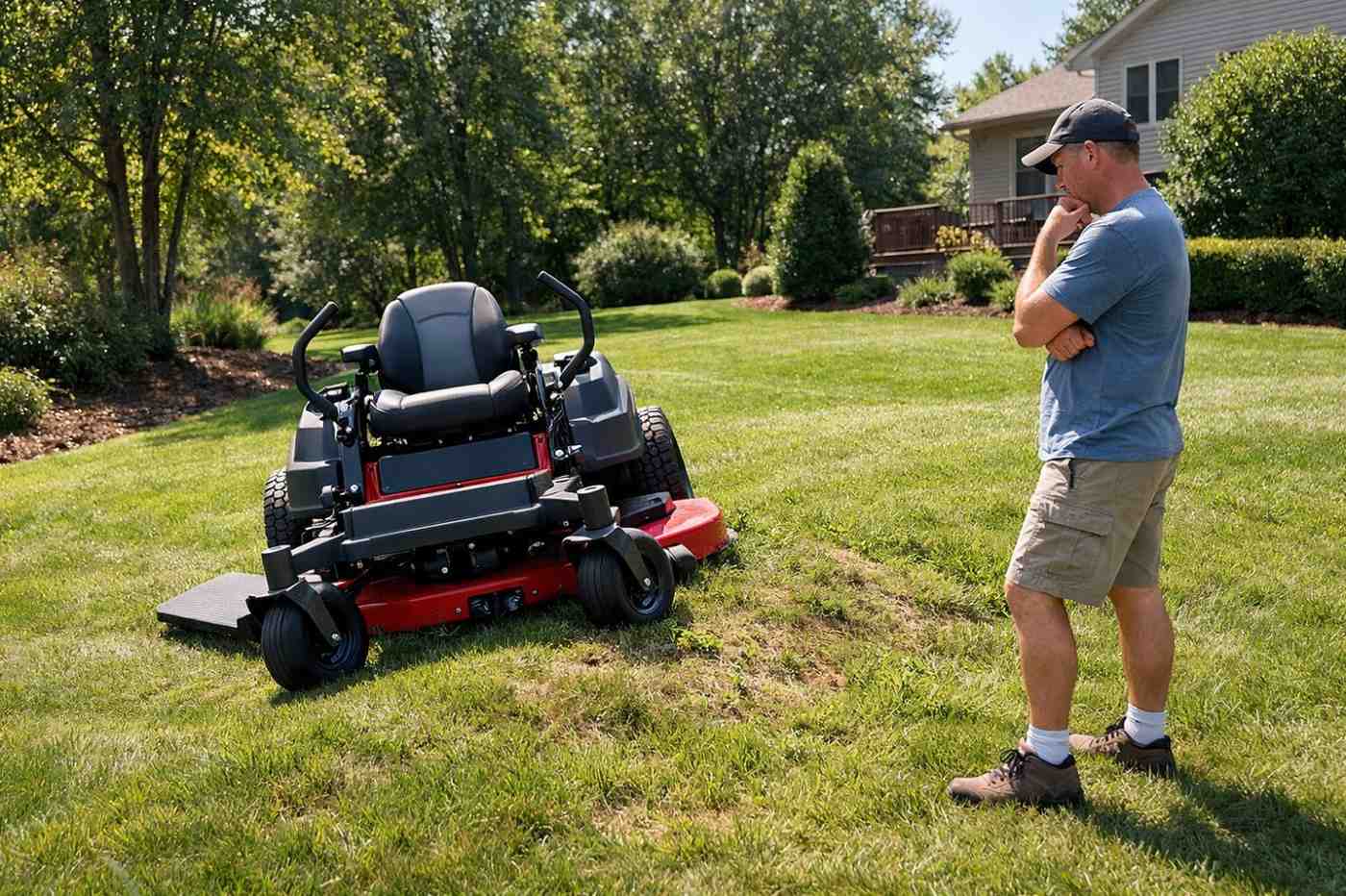
- Turf Tearing: If an operator executes a true zero-degree pivot turn on soft or sensitive turfgrasses, the inner rear tire stops completely, while the outer tire still spins. This action creates a grinding shear force that can rip grass roots directly out of the topsoil. The result is a bunch of ugly, muddy ruts in your yard.
- Higher Upfront and Repair Costs: Entry-level zero-turn mowers cost significantly more than entry-level lawn tractors of the same deck width. Furthermore, because they utilize two independent hydrostatic transmissions instead of a single manual or automatic transmission, routine maintenance and long-term repair costs are basically doubled.
Will a ZTR Work for You?
To prevent a costly mismatch between your machinery and your land, follow our guide to test whether these weaknesses will outweigh its benefits in your specific scenario.
- Calculate Slopes on Your Land
With a digital inclinometer or smartphone app, walk your property line and identify drainage ditches, retention ponds, and other similar hangups. Place a straight board along the incline and measure the angle with a digital level. If any slope registers above 15 degrees, a standard zero-turn cannot be safely operated across that section.
- Turf Varieties and Soil Density
Examine your lawn composition. If your property features high-moisture zones carpeted with St. Augustine grass or loose, sandy soils of Bahia grass (both common locally), a heavy zero-turn machine will sink into the soft spots. The tire tread required for ZTR traction will easily slice through shallow stolons (above-ground runners) when maneuvering around landscape beds, too. You don’t want that.
- Map Out Obstacles and Clearances
Measure the clearance of your property gates and paths between buildings or mature trees. Zero-turn decks are wide, typically ranging from 42 inches to over 72 inches, and feature prominent side-discharge chutes. Unlike traditional lawn tractors that allow you to easily navigate tight corners, a zero-turn requires a wider clearance radius to swing its rear end around when pivoting away from whatever obstacle you’re trying to avoid.
- Evaluate Long-Term Utility Requirements
If your checklist of outdoor chores includes things like spreading heavy loads of lime or fertilizer annually or moving a similarly hefty amount of firewood, a zero-turn’s hydraulic system will likely choke under the strain. In this scenario, the mechanical limitation of a ZTR means you will either need to purchase a secondary utility vehicle or opt for a heavy-duty garden tractor instead.
Lock it in With Lane’s Yardware!
Recognizing the flaws of a zero-turn mower doesn’t mean you shouldn’t buy one! It just means you need to get a machine engineered to overcome those flaws, backed by local expertise. This is where Lane’s Yardware, located at 19 E Noble Ave in Williston, Florida, changes the game.
We anchor our inventory with Gravely zero-turn platforms that are built with fully welded, high-strength steel frames that resist twisting forces on all your uneven land. To boot, our competitive financing programs are designed to match any budget. With low-APR options, flexible terms, and fast, on-site approval, it’s never been easier to get out the door with the perfect machine at an equally perfect price.
Don’t let a sub-par mower turn your regular routine into a stressful chore. If your current machine is struggling, it’s time to get with the experts.
At Lane’s Yardware, we help you bypass the hidden pitfalls of generic, big-box mowers. We’ll pair you with a machine that is engineered to endure the long haul. Contact us today!